What Do More Data Centers Mean for Oregonians?
July 9, 2026 Energy Efficiency, Advocacy
Data centers are a growing issue across the state. Oregon is among the top 10 states for data center development. What makes Oregon so desirable and what does their presence mean for Oregonians?
What is a Data Center?
More of our daily lives now exist “in the cloud”. Every email we send, photo we store, online purchase we make, or AI prompt we submit is stored and processed in a building called a data center. Data centers are the physical infrastructure of the internet, allowing us to store, process, and move data. They are also critical for the expansion of artificial intelligence (AI), which uses data centers like a classroom.
AI investment is largely responsible for the boom in data center development. These facilities are built and operated by “hyperscalers” or large-scale cloud service providers. We know them by names such as Google, Microsoft, and Amazon.
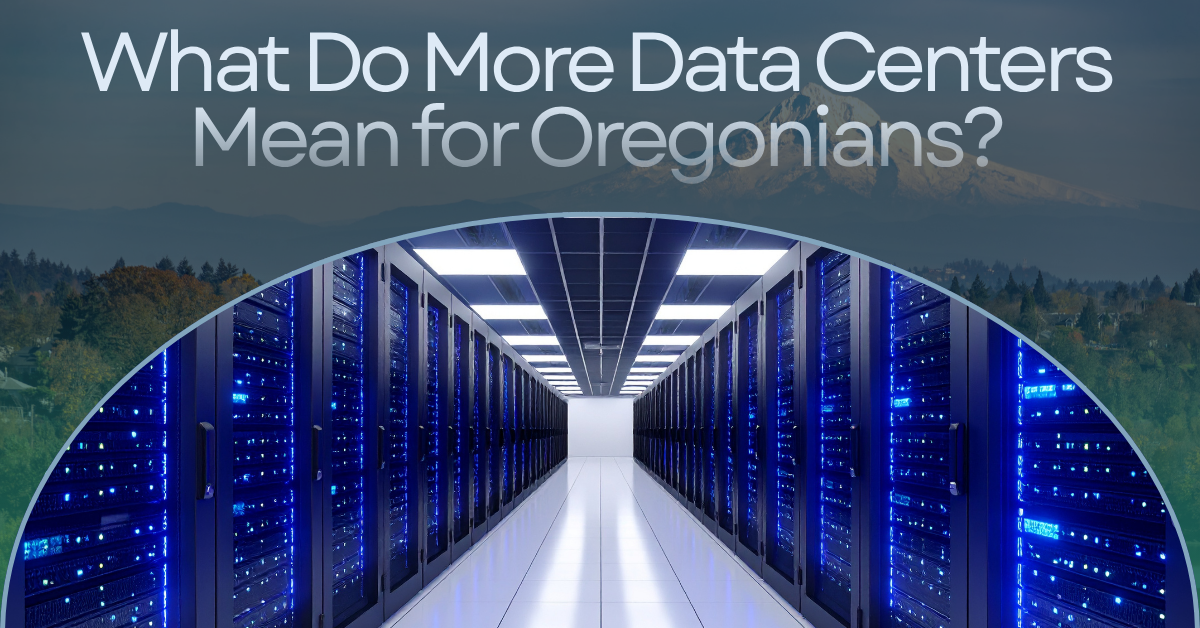
From the outside, data centers look like unassuming warehouses, but inside there are hundreds of rows of servers operating 24 hours a day. Any interruption can disrupt activities such as the fulfilment of an Amazon order or the operation of a hospital’s medical equipment. These systems operate around the clock, data centers are designed with extensive backup systems to minimize disruptions.
Massive amounts of energy are needed to keep this technology online. And just like your computer at the end of a long work day or gaming session, these servers get hot. More energy is needed to constantly cool the data centers to keep the inside temperature at an optimal range for the servers’ functionality. This need is even greater within AI data centers. Some facilities also use fresh water cooling systems to improve energy efficiency, though this creates tradeoffs for local water resources. In 2025, Google’s data centers in The Dalles, Oregon used nearly 550 million gallons of water from the Columbia River.
Why Are Data Centers Coming to Oregon?
According to Data Center Map, there are 125 data centers operating in Oregon. Oregon is an ideal location for data centers for some of the same reasons you probably enjoy living here:
Reliable, affordable energy
Low risk of natural disasters
Cooler climate
Lots of undeveloped land
There are two additional factors that are especially important to the tech industry:
Tax savings: Oregon has no sales tax, which means tech companies can save millions of dollars on data center equipment. Oregon also allows local governments to grant unlimited property tax breaks to tech companies. According to The Oregonian, data centers will avoid paying more than $450 million in Oregon property taxes in 2026 alone.
Global connectivity: Hillsboro is directly connected to the Asia-Pacific region through high-speed subsea fiber optic cables. Hillsboro has 42 data centers according to Data Center Map, earning it the nickname “Data Center Alley.”
What Are the Risks With Data Centers?
As the demand for data centers grows across Oregon, the demand for energy is also increasing. A single hyperscale, 100 MW data center uses as much energy as 84,000 residential customers. A 400 MW load is about the equivalent of serving the residential needs of the city of Portland. But modern data centers are becoming much larger; Amazon is proposing to build a 1 GW “exascale data center development” in Boardman, Oregon.
This increase in energy use strains the grid and requires utilities to expand infrastructure and add new sources of electricity, which might mean purchasing it from other states. Not only are these investments costly to utility companies and potentially residential customers, experts have warned that electricity affordability could become a growing concern if new electricity demand outpaces new supply.
Oregon is also at risk of missing our HB 2021 goals to reduce emissions 80% by 2030. Adding thousands of MWs from data centers will make emissions reduction even more difficult, especially with ongoing federal policy and permitting challenges affecting renewable energy development.
Other risks to local communities include:
Air and water pollution
Sound pollution
Land and economic trade-offs: Land may be taken for data center development that supports other economic activities such as agriculture. Data center development can provide many construction jobs but offers few permanent positions.
Stranded assets: As technology evolves, data centers built today may become obsolete and abandoned in favor of new technology.
How is Oregon Regulating Data Centers?
The Oregon legislature passed the POWER Act in 2025. This law created a new class of utility customers—users over 20 MW—to hold them accountable for their electricity use and cost.
CEP and other advocates were involved in negotiations with PGE to implement the POWER Act. The ruling announced in May 2026 specifies that data centers will have to pay for all the energy costs for their development and operation. The ruling imposes renewable energy requirements on data centers before coming online, and requires them to pay “exit fees” if they decide to stop work before completing a project. It also adds a surcharge that will fund energy efficiency upgrades for low-income households.
PGE filed a request in June 2026 to increase data center rates by 29%. Residential customers will see a 1.3% decrease in their rates.
CEP is currently involved in POWER Act negotiations with PacifiCorps and hopes to secure similar regulations that benefit residential customers.