
Hillsboro Extreme Weather and Community Resilience

Hosted by Community Energy Project (CEP) and The City of HillsboroHeld June 1, 2024, 10am- 1pm at Hillsboro public library This listening session was held in order to get direct community feedback for the City of Hillsboro and Community Energy Project (CEP) and envision what a resilient neighborhood would look like in preparation of extreme weather events. The focus was on energy efficiency, solar power, and microgrids.
Goals
Learn about levels of preparedness during extreme weather events (as individuals and as a community)
Gain insight on how community members would like to be informed and prepared when extreme weather events happen
Learn what the community would want in a resiliency hub in the Hillsboro area
About the Participants
Residents live in the Calle Diaz neighborhood, an area with a significant Latine population and an exceptionally high energy burden for Hillsboro. 15 participants (10 adults and 5 children) across 9 households took part. Over 80% of the participants were renters, Latine, and immigrants and all were low-income.
Outreach Methods
CEP utilized a network of existing relationships forged through community solar, providing free workshops, and performing free home energy score assessments. Our focus was on specifically reaching the Latine population in Hillsboro. The event was also promoted through CEP’s newsletter and the City of Hillsboro’s website.
Participant Compensation
At the end of the session, each household received a $100 gift card as compensation for their time and expertise. Additionally, a variety of raffle prizes were provided to encourage active participation throughout the session.
Accessibility
Community Energy Project prioritizes accessibility when working directly with the community. Knowing some of the most common barriers, CEP provided:
A Spanish interpreter and translated materials
Saturday morning session to accommodate common work, school, and religious schedules
Food and beverages that accommodates many dietary restrictions
A kids area with games and toys, allowing parents to fully engage with the session
Listening Session Questions and Results
CEP has provided community education for decades, and is well-versed in making technical information accessible to the general public. Session content works well across language barriers, literacy levels, and creates opportunities for further clarification. The session was designed to encourage people to think deeply about specific questions.

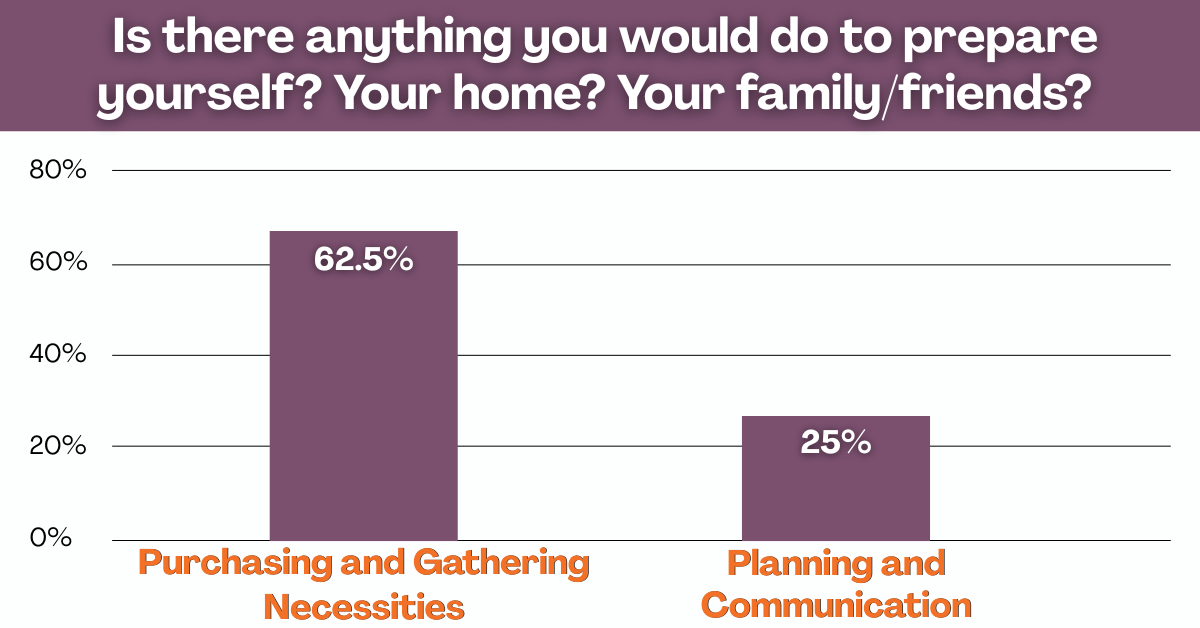


“I would like to have a plan and a safe place to go for friends and family where the community can go. Or to have more classes so we may know how to prepare. Have a list of items of emergency to prepare. I have a small list but I'm not sure if it's appropriate.” - Listening Session Participant
What is the worst weather event you have ever experienced?
How did you prepare?
How did you find out it was going to happen?
Are there resources or services you would want but may not exist in your community?
During this extreme weather event…
Would you leave your home to go to a resilience center?
Who else from your community would be at the resilience center?
What would the center look like?
How close would the resilience center need to be to your home to be accessible to you? Via walking, biking, driving, transit?
What resources would the center have beyond being a place to shelter?
In extreme heat (wildfire) and extreme cold (ice storm), how do you get news about these weather events?
What source do you trust to learn about this upcoming weather and to receive updates as it is happening?
What concerns do you have about you and your family’s personal safety and health?
Are there any actions you would take to prepare your home?
If you or someone in your home has to go to work, are there any extra precautions that should be taken? Any specific concerns to consider? Any policies you know about that would take effect?
“I worry about any heat strokes, heat exhaustion, or dehydration as well because mother and father are older and bad lungs can have problems when it is too hot. My dad has a machine that needs electricity.” - Listening Session Participant
When asked where participants receive information on extreme weather events, the majority said social media or through the local news. These sources are often where they find updated information throughout the weather event. Many of the participants also stated that their biggest safety concern was a potential power outage. Though many rely on power for information updates, food security, medical needs, and other critical resources, participants shared that they have minimal preparation knowledge and want to learn how to keep their families safe and comfortable at home. Participants also suggested that more emergency preparation classes be taught in schools to ensure that all members of their household are informed on how to respond and stay safe during an extreme weather event.
Resource Hub Conversation
“The safety location should have sufficient space for each family and their pets. Along with plenty of food and first aid supplies for emergency needs.” - Listening Session Participant
Participants shared key safety concerns that needed to be addressed before they would be willing to utilize a resource hub, including:
Policing and safety of area
Participants were concerned about who would have access to the resilience hub and what measures would be in place to prevent overcrowding and maintain safety.
Safety with children
Participants also mentioned that they would want these centers to have spaces equipped to help families and keep them together during this event.
We asked participants what would make this space feel safe and welcomed to you? Nearly all the participants said that they would like to see increased organization and more information about the resilience hub’s safety practices before sheltering there during weather events. Additionally, they would like some sort of security to be present during weather events to maintain order during the chaos.
Participant Comments:
When discussing the possibility of having to evacuate during extreme weather, we wanted to learn about participants’ concerns with leaving their homes and what they want to see in the resilience hub in their communities.
What concerns do you have about you and your family's personal safety and health?
“Pipes freezing, transportation halting in winter. Supplies: firewood to warm home, blankets. It's important to teach these things to the youth so they can prepare themselves.”
What are some must-haves for you, your family, and your friends in a resilience hub?
“That these locations are safe to stay in.”
“A gas generator, a place that could support extreme cold weather. If there is an emergency, there would be a place to go if not the hospital.”
CEP’s Session Takeaways and Use in Advocacy Work:
In collaboration with the City of Hillsboro, CEP used this feedback to help develop a joint proposal to retrofit buildings and distribute resources to reduce energy burden and greenhouse gas emissions while improving indoor air quality, health, comfort, and safety.With the growing climate crisis, community resource hubs and resiliency centers are going to become a forefront topic for frontline communities. This listening session provided better understanding of community needs during extreme weather events and how the Oregon Public Utility Commission (PUC), utilities, and other organizations can help utility customers be more prepared. CEP brings community knowledge to environmental justice spaces within the PUC to ensure increased, systematic community resilience.
Participants brought up a wide variety of complicated issues surrounding resource hubs, especially in regards to sheltering in place. These concerns ranged from security to hub access – highlighting the need to engage community members early on during resource hub planning, in order to hear and manage concerns. CEP recognizes that for some communities, police and security can provide a feeling of safety, while other communities would feel (and are) less safe. Additionally, we understand that local and federal government policies and social trends may shift community members’ feelings of safety and comfort over time. When considering potential stakeholders for listening sessions:
Consider the history of the area. If it has been heavily gentrified, understand that there may be a relatively recent memory of traumas that should be factored in.
Involve many groups, not just vocal groups that tend to be well-represented in many places.
Consider the current political / cultural arena locally and nationally that may impact current motives and concerns.
Create a clear vision for what is needed from the community to be informed, whether a resource hub is simply a place to charge electronic equipment or if it is meant for sheltering in place for days or overnight.